
How do we apply acoustics?
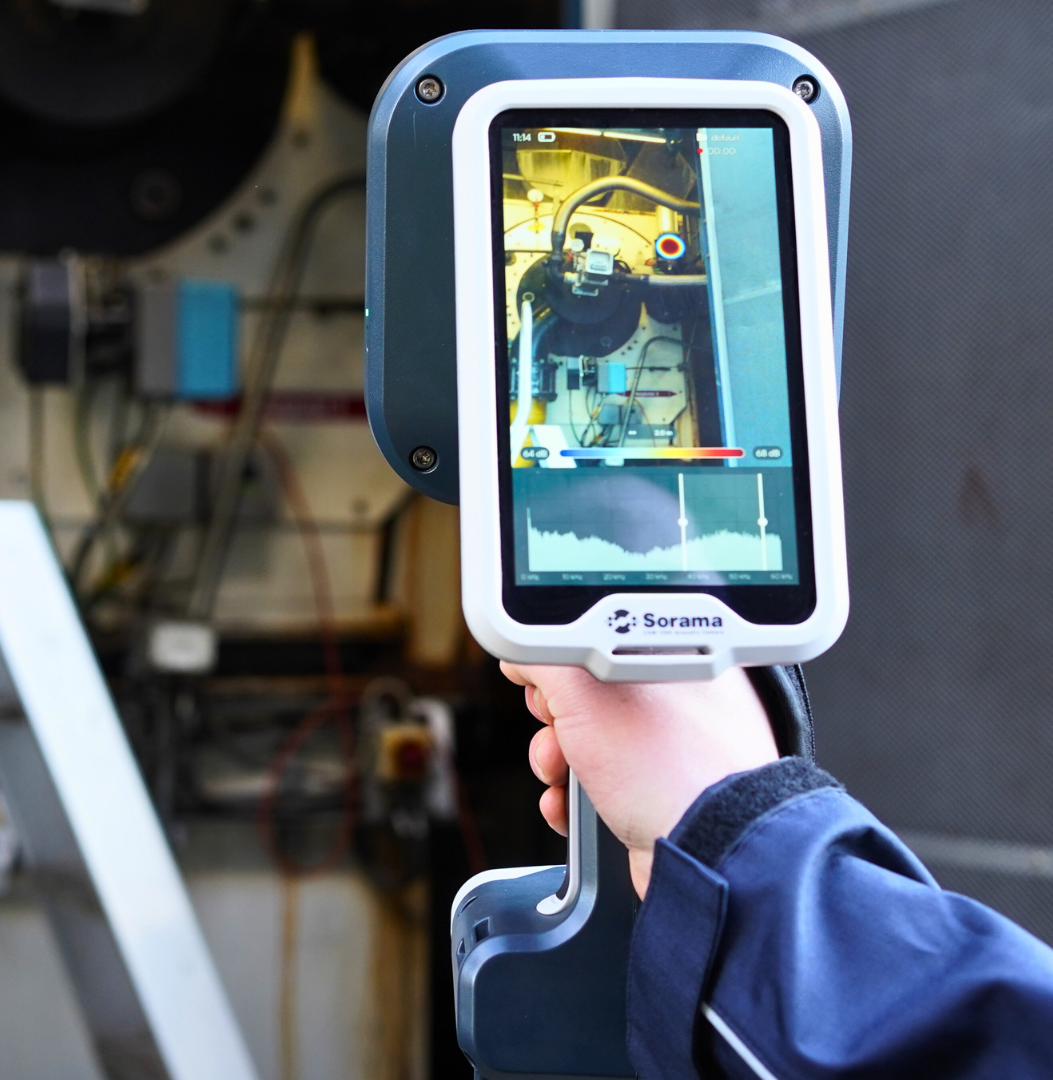
Sorama makes sound visible and measurable so people can act on it with confidence
We localize, map, classify, and quantify sound in real environments where performance, safety, and experience matter.
Sound influences how we feel and how systems behave. Continuous exposure to unwanted noise increases stress levels and affects concentration and recovery. In industrial settings, abnormal sound often signals energy loss or mechanical issues before failure occurs. In stadiums, sound shapes atmosphere and player experience. But because sound is invisible, these signals are easy to miss.
When we visualize sound, it becomes structured data. You see where it comes from, how it spreads, what it is, and how strong it is. That turns sound from background noise into a tool for decision-making.
In practice, our technology answers four core questions: Where is it coming from? How does it spread? What it is? How strong it is? Together, they form a complete picture.
Where is the sound coming from?
Localization
Localization determines the exact position of a sound source in space. An acoustic camera uses an array of microphones to measure time differences in sound arrival. Sound reaches each microphone at slightly different times.
By comparing those timing differences, the system can figure out where the sound is coming from. This applies to both audible and ultrasonic frequencies.
/1080%20x%20608/LB_HVAC.jpg "LB_HVAC")
Real-world scenarios
/1920%20x%201080/SI_Hydrogen.jpg?width=1920&height=1080&name=SI_Hydrogen.jpg "SI_Hydrogen")
Hydrogen production
/1920%20x%201080/LB_Blob.jpg?width=1920&height=1080&name=LB_Blob.jpg "LB_Blob")
Building façades
Large façades contain many joints and seals. Acoustic scanning highlights the precise spots where air or sound escapes, making it faster to inspect than traditional methods.
/1920%20x%201080/LC_LVD-at-night.jpg?width=1920&height=1080&name=LC_LVD-at-night.jpg "LC_LVD-at-night")
Traffic enforcement
In heavy traffic, multiple vehicles pass at once. Localization pinpoints which vehicle produces a noise violation. This makes noise enforcement targeted and legally defensible.
/1920%20x%201080/SP_NAH-of-firetruck.jpg?width=1920&height=1080&name=SP_NAH-of-firetruck.jpg "SP_NAH-of-firetruck")
How is sound distributed across a space?
Mapping
Mapping shows how sound spreads within an area. Instead of measuring one point, the system reconstructs the sound field. The result is a spatial heatmap that reveals where sound concentrates, weakens, and shifts over time. Mapping moves from a single value to a spatial overview. Not just how loud, but where and how it behaves.
Real-world scenarios
/1920%20x%201080/FanSound_FIBA.jpg?width=1920&height=1080&name=FanSound_FIBA.jpg "FanSound_FIBA")
Fan engagement
Mapping visualizes crowd energy across tribunes. A live heatmap shows where atmosphere peaks and how it shifts during key moments. Clubs identify engaged sections and track atmosphere throughout the game.
/1920%20x%201080/SI_Complex-industrial-site.jpg?width=1920&height=1080&name=SI_Complex-industrial-site.jpg "SI_Complex-industrial-site")
Industrial plants
Mapping shows noise distribution across production halls. Teams see high-exposure zones in one overview. This supports safety planning and layout improvements. Sound becomes a spatial safety indicator.
/1080%20x%20608/LC_LVD.jpg?width=1080&height=608&name=LC_LVD.jpg "LC_LVD")
Urban planning
Mapping reveals how traffic or nightlife noise spreads across neighborhoods. This supports decisions about residential development, zoning, and mitigation measures. It helps determine whether an area is suitable for housing or requires acoustic intervention first.
What kind of sound is it?
Classification
Classification determines what type of sound is occurring. The system analyzes frequency content and temporal patterns. It compares them to trained models and assigns a label, such as leak, vehicle, cheering, or anomaly. Instead of treating everything as noise, it separates relevant events from background activity.
/1920%20x%201080/LC_Airport-L642.jpg?width=1920&height=1080&name=LC_Airport-L642.jpg "LC_Airport-L642")
Real-world scenarios
/1920%20x%201080/Vergeer%20employee%20using%20Sorama%20camera.jpg?width=1920&height=1080&name=Vergeer%20employee%20using%20Sorama%20camera.jpg "Vergeer employee using Sorama camera")
Factory equipment
Machines produce stable acoustic patterns during normal operation. When wear or misalignment develops, the pattern changes. Classification detects the deviation and flags it early. Sound becomes a fault indicator.
/1920%20x%201080/FanSound_FIBA-6.jpg?width=1920&height=1080&name=FanSound_FIBA-6.jpg "FanSound_FIBA-6")
Crowd behavior
Crowd sound includes cheering, chanting, music, and disturbances. Classification distinguishes normal chants from aggressive behavior. Operators gain objective insight into crowd dynamics.
/1920%20x%201080/LC_Eindhoven-intersection.jpg?width=1920&height=1080&name=LC_Eindhoven-intersection.jpg "LC_Eindhoven-intersection")
Public safety
In nightlife districts, the system differentiates regular street noise from breaking glass or other aggression signals. Authorities focus attention where acoustic patterns indicate risk.
/1920%20x%201080/Sorama-FanSound-at-Padel-week.jpg?width=1920&height=1080&name=Sorama-FanSound-at-Padel-week.jpg "Sorama-FanSound-at-Padel-week")
How strong is the sound?
Quantification
Quantification measures sound in objective, standardized terms. The system calculates sound pressure levels, frequency, and exposure over time. Teams work with measurable values in decibels and related metrics. It answers how loud, how often, and how impactful the sound is.
Real-world scenarios
/1920%20x%201080/LB_blob_3.jpg?width=1920&height=1080&name=LB_blob_3.jpg "LB_blob_3")
Building performance
Quantification ranks leakage points by measured level. Teams fix the most critical first. After repairs, the team confirm the improvements, like this sound becomes a performance metric.
/1920%20x%201080/SP_Drone_acoustic-analysis.jpg?width=1920&height=1080&name=SP_Drone_acoustic-analysis.jpg "SP_Drone_acoustic-analysis")
Product development
In product design, engineers need to understand how sound behaves inside their products, and how it affects user experience. This allows teams to verify improvements, compare design iterations, and make decisions based on real data instead of assumptions.
/1920%20x%201080/LC_PSV-stadium-drone-shot.jpg?width=1920&height=1080&name=LC_PSV-stadium-drone-shot.jpg "LC_PSV-stadium-drone-shot")
Stadiums and venues
How to use it in practice?
/1920%20x%201080/SI_Handheld-gas-leaks.jpg?width=1920&height=1080&name=SI_Handheld-gas-leaks.jpg)
What is an acoustic camera?
Portable acoustic cameras support inspections and diagnostics.
/1920%20x%201080/SI_L642_2.jpg?width=1920&height=1080&name=SI_L642_2.jpg)
What is an acoustic monitor?
Fixed acoustic monitors enable continuous monitoring and trend analysis.
Frequently Asked Questions
How is acoustic imaging different from a sound level meter?
A sound level meter gives one measurement at one point. Acoustic imaging shows where sound comes from and how it behaves across a space. That helps teams move from measuring noise to understanding and fixing it.
When should you use acoustic localization instead of traditional inspection?
Use acoustic localization when the source is hard to find, safety matters, or speed is critical. It is especially useful for leaks, abnormal machine sound, façade leakage, and moving noise sources such as vehicles.
Can Sorama measure both audible and ultrasonic sound?
Yes. Sorama solutions can work with both audible and ultrasonic sound, depending on the application. That makes them useful for cases such as hydrogen leaks, compressed air leaks, mechanical issues, and environmental noise.
What kinds of problems can sound reveal before they are visible?
Sound can reveal leaks, friction, wear, misalignment, turbulence, and other early-stage issues before they become visible failures. That gives teams a faster way to detect problems and act sooner.
Why is visualizing sound more useful than only measuring it?
A single value tells you there is sound. A visual map shows where it starts, how it spreads, and which source matters most. That makes it easier to prioritize action and explain findings to others.
How does acoustic data support better decisions?
Acoustic data helps teams move from assumptions to evidence. They can compare locations, rank issues, confirm improvements, support compliance, and focus effort where it has the biggest effect.
Which industries use acoustic imaging and sound analysis?
Acoustic imaging and sound analysis are used in industry, energy, buildings, cities, infrastructure, and sports venues. Common use cases include leak detection, fault detection, façade testing, traffic noise insight, and crowd measurement.
What can Sorama help you understand about a sound?
Sorama helps you understand where sound comes from, how it spreads, what type of sound it is, and how strong or significant it is. Together, that gives a fuller picture than a single sound reading alone.